Air Blasters- The Solution for Effective Material Flow Management
Air blasters (Air Cannons) of high performance for material flow are provided by us at Ubon India . Whether the industry is that of cement, steel, sugar, coal mining, sponge iron, power plant and many more. it does not matter. Our air cannons system prevents blockage and build-up in essential equipment like silos, hoppers, chutes, and kilns, making the material flow smooth and undisturbed.
As a trusted industrial air blaster manufacturer in India, Ubon India provides reliable, advanced solutions to keep your operations running at peak performance.
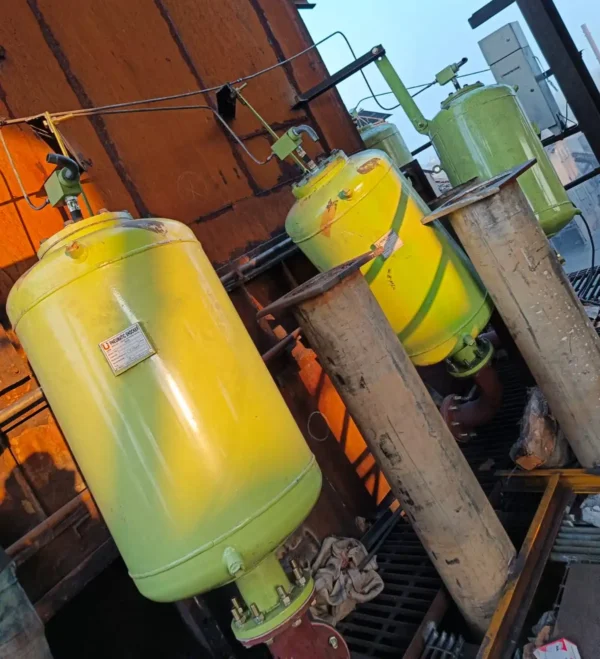
What Is an Industrial Air Blaster?
Air blasters use 100+ PSI bursts of air to remove obstructions in silos, hoppers, or chutes to provide free flow for cement, coal, and bulk materials. Portable, non-invasive, and chemical-free, they replace hazardous manual clearing.
IoT sensors and AI-enabled models provide new models with automated capabilities, while explosion-proof or corrosion-resistant models provide harsh environment applications. Green and sustainable, they recycle air and eschew chemical cleaners, minimizing waste.
Innovations like low-pressure models accommodate sensitive products, and energy-recovery systems maximize sustainability. With force coupled with finesse, air blasters minimize downtime, maximize safety, and redefine industrial productivity—proving air is the ultimate tool.
Why Air Blasters Are Needed for Your Business
- Prevent Blockages: Prevent material accumulation, which promotes smooth and constant flow.
- Reduce Downtime: Regular air blasts keep material flowing, reducing shutdowns due to obstruction.
- Improve Efficiency: Clear the blockages very fast, ensuring the overall plant productivity is at its best.
- Energy Efficiency: Optimize airflow such that energy usage is at an optimal level.
- Equipment Protection: Unlike manual cleaning, air bursts don't damage your equipment, giving your machines more life.
Schematic Diagram of Air Blaster Installation In Cement Pre-Heater
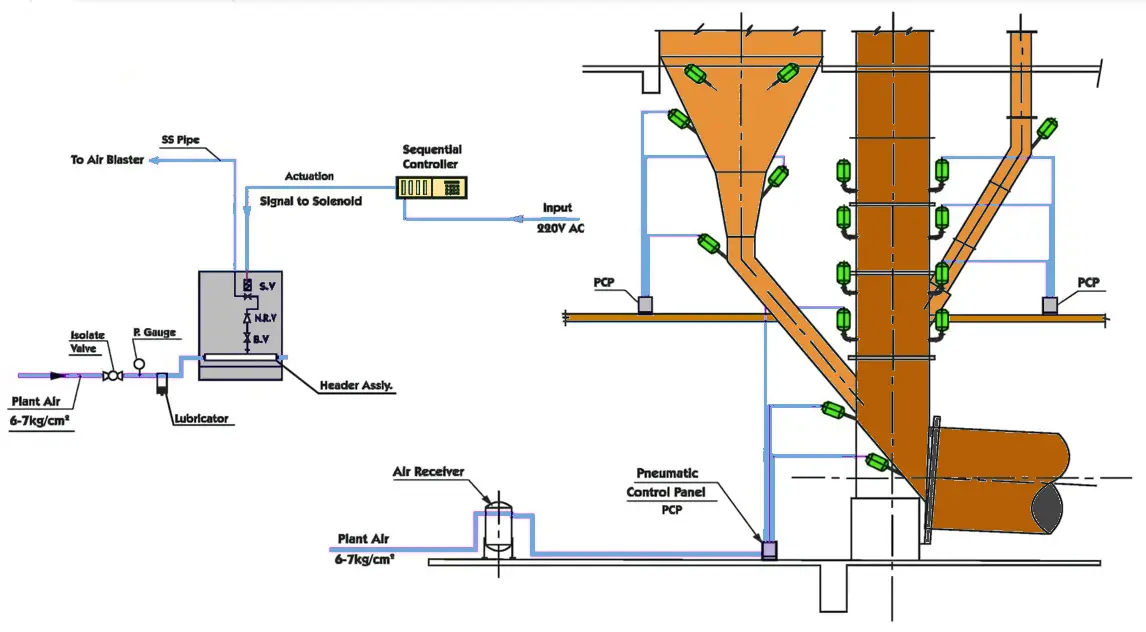
How Air Blasters Work
Air blasters solve material clogging in silos, hoppers, or conveyors with precise, high-pressure bursts of air (100+ PSI), removing stubborn cement, coal, or aggregates without equipment wear. Air blaster systems provide controlled air pulses to clogged areas, restoring flow and preventing costly downtime.
High-end upgrades include IoT-based controls for programmed or sensor-activated initiation, reducing energy wastage, and adaptive nozzles for targeted cleaning. Compared to mechanical solutions, they minimize machinery wear and prevent toxic chemical cleaning agents, which is eco-friendly manufacturing.
Upgrades like low-energy designs and explosion-proof models solve volatile or sensitive materials. By combining power and precision, air blasters run at maximum efficiency while reducing operating costs and safety risks.
Common Flow Problems in Plants
Material flow problems in bulk material handling systems are common in plants, causing considerable production delays. Some of the common flow problems are as follows:
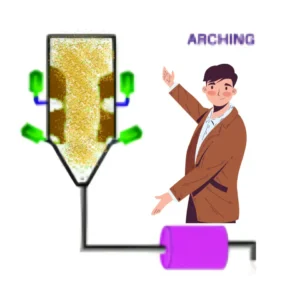
Arching:
Arching occurs when material builds up and forms a bridge-like structure across the flow path, blocking the movement of material. This creates a complete blockage, halting the flow entirely. Air cannons can break the arch and restore the flow by releasing powerful bursts of air to dislodge the material.
Bridging:
this occurs when material bridges over equipment, thus preventing it from falling freely and also restricting the downward flow. This blockage will cause delays in production because of the restriction of material movement. Blasters can easily dislodge the bridge, clearing the obstruction and allowing the material to flow properly
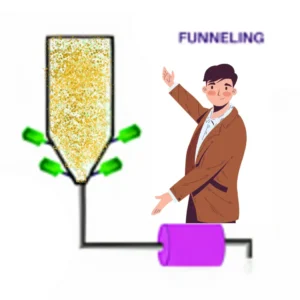
Funneling:
it is a situation where material flows mainly from the center of the chute or hopper, leaving the material on the sides to stagnate. This type of uneven flow will not be efficient and prevent the equipment from emptying. Strategically placed blasters will ensure even distribution of material flow for smooth operation and maximum utilization.
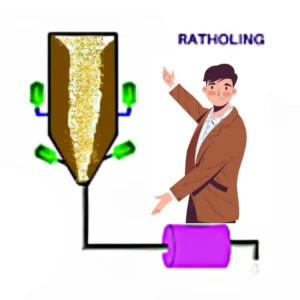
Rat-holing:
A narrow channel forms in the center of the bulk material leaving the surrounding material untouched. The result is an incomplete material discharge and uneven flow, which are inefficient for the system. Cannons break up the rat hole and encourage a consistent flow of material.
These common flow problems can greatly hinder productivity and efficiency. Using industrial air cannon helps to address such problems and ensure that material continues to flow uninterrupted, reliably maintaining continuous operations in industries such as cement plants, sugar mills, and coal mines.

How Industrial Air cannons Address the Problems
Strategically placed Industrial air cannonsfor silos, Hopper, Chute will resolve the material flow problem,hopper flow problems, dislodge the material trapped, and allow for a continuous flow. Depending on your plant design and material handling system, our air cannons solutions can be modified to suit your specific needs and ensure that your production line continues without interruption.
The Key Benefits of Air Cannons
- Increased Productivity: Ensure continuous material flow for higher throughput.
- Cost Savings: Avoid costly downtime and maintenance, with ensured efficient work through your equipment.
- Safe Working Environment: Avoid the inconvenience and risk of manual handling to clear blockages.
- Energy Efficient: Consume less fuel while optimizing energy use for airflow.
- Durability: Durable in all industrial operations; our systems are reliable and durable.
Applications of Industrial Air Blasters in Different Industries
Air Blasters find wide applications across different industries where smooth material flow needs to be ensured. Our cannons cater to the following industrial applications as well.
- Cement Plants: Prevent blockage of silos, hoppers, and kilns in Cement Plants for smooth operation.
- Sugar Mills: Clear up the material accumulated in conveyors and hoppers of Sugar Mills to ensure material flow.
- Coal Mines: Provide a steady air blast to maintain coal flow in storage bins and chutes.
- Steel Plants: Ensure that large storage areas and conveyors remain free from material in steel plant.
- Power Plants: Ensure a free flow of coal and other materials through feeders and boilers in power plant.
- Sponge Iron: Remove blockages of materials which cause disruptions in Sponge Iron Plant production.
- Petrochemical Plants: Ensure uninterrupted flow of bulk material processing systems.
Solution to Fit Your Plant
We, at Ubon India, provide solutions according to your specific requirements at the plant. Our systems are easy to install, have minimum maintenance, and ensure maximum performance. We also provide professional installation services and periodic maintenance with troubleshooting so that the blasters perform their functions effectively.
Technical Specifications Of Various Models
| Model | Discharge | Tank Cap (Liters) | Application |
|---|---|---|---|
| PS-2-09 | 50mm | 09 | Chutes, Feed Pipes, Section |
| PS-2-12 | 50mm | 12 | Chutes, Feed Pipes, Section |
| PS-2-20 | 50mm | 20 | Chutes, Feed Pipes, Section |
| PS-2-30 | 50mm | 30 | Chutes, Feed Pipes, Section |
| PS-4-50 | 100mm | 50 | Chutes, Feed Pipes |
| PS-4-70 | 100mm | 70 | Chutes, Feed Pipes |
| PS-4-100 | 100mm | 100 | Chutes, Feed Pipes, Cyclone |
| PS-4-110 | 100mm | 110 | Chutes, Feed Pipes, Cyclone, Riser Duct |
| PS-4-150 | 100mm | 150 | Pre-cyclone, Riser Duct, Cooler, Hopper |
| PS-6-100 | 150mm | 100 | Cyclone, Hoppers, Cooler |
| PS-6-150 | 150mm | 150 | Cyclone, Hoppers, Cooler |
| PS-6-200 | 150mm | 200 | Same as above |
| PS-6-250 | 150mm | 250 | Same as above |
| PS-6-300 | 150mm | 300 | Same as above |
Why choose Ubon India for Reliable Solutions?
- Expertise: Years of experience mean we can offer top-notch solutions to material flow challenges.
- Customization: We tailor the air blasters system according to your plant's specific needs.
- Technology: Our air cannons come with cutting-edge technology for maximum efficiency and durability.
- Complete Support: Our full-service solution includes installation, maintenance, and optimization.
- Global Presence: Serving clients worldwide, Ubon India is your partner for efficient material handling.